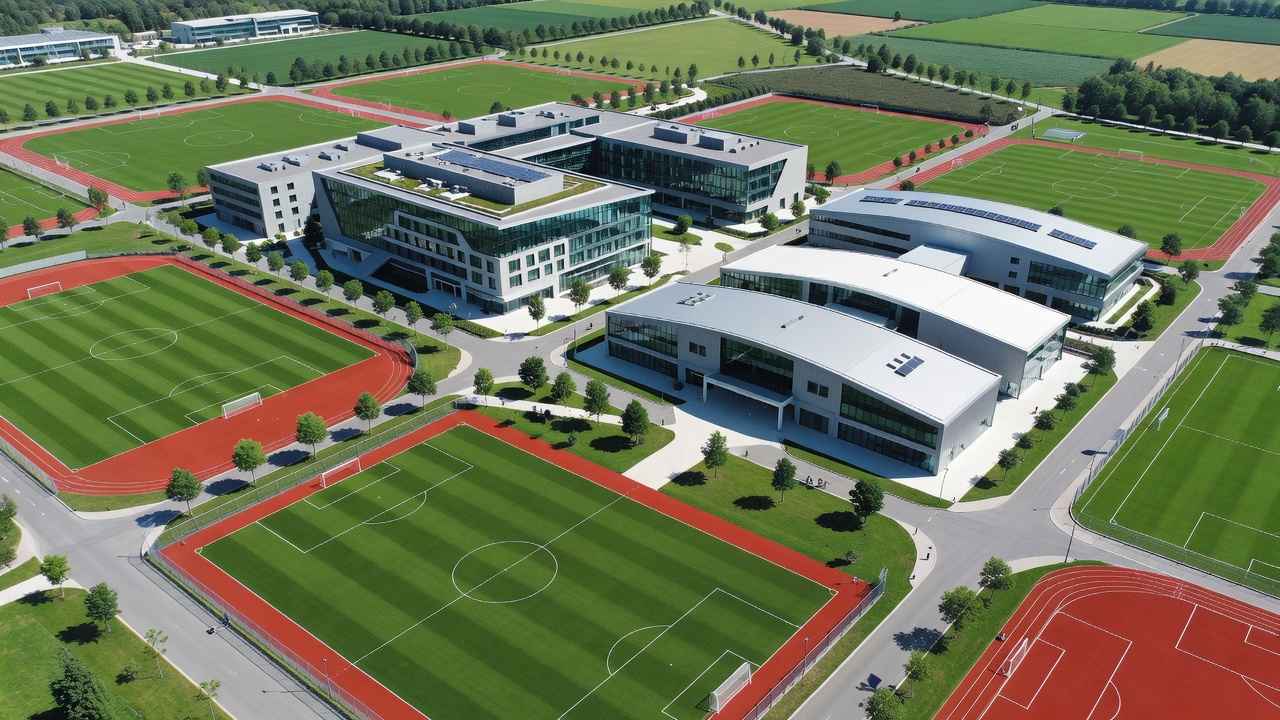
Facility types
Modern European academies are less a single training ground and more a campus: a place where training, education, recovery and daily life are designed to work together.
Training pitches
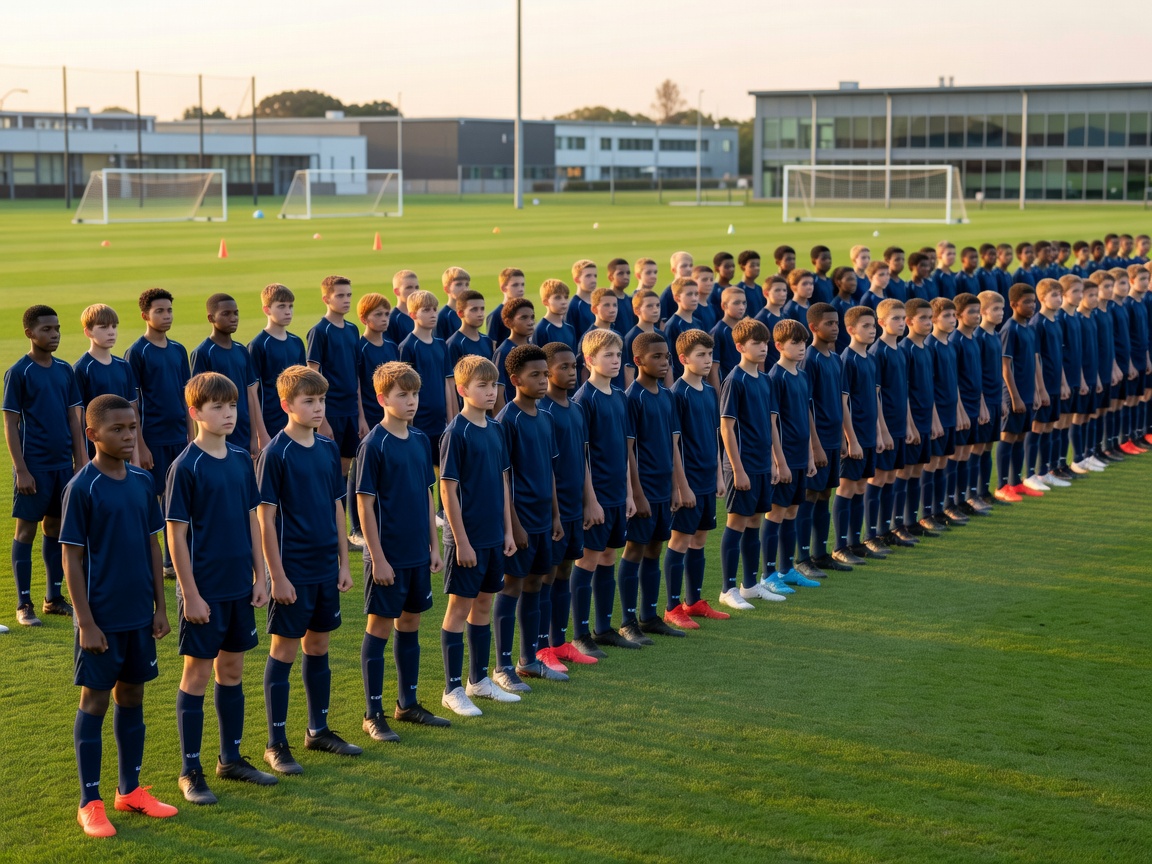
Every academy relies on multiple pitches so that different age groups can train at the same time. A mix of natural grass and artificial surfaces allows sessions to continue in poor weather and lets coaches match the surface to the session.
Indoor spaces
Indoor halls and covered areas protect technical work during winter, which matters more in central and northern Europe than on the Iberian peninsula. They are also used for futsal-style games, coordination work and small-group sessions.
Gym and sports science
Strength and conditioning areas are supervised by specialist staff, particularly for older age groups. Physical testing and monitoring help coaches adapt training loads to players who are growing quickly.
Medical and recovery
Physiotherapy rooms, rehabilitation spaces and recovery facilities support injury prevention and return to play. For young athletes, growth-related issues are a particular focus.
Residences
Several academies provide boarding for players who live away from home. La Masia's residence at the Ciutat Esportiva Joan Gamper, the residential facilities at Benfica's Seixal campus and Sporting CP's Alcochete academy, and the boarding facility at the FC Bayern Campus are examples.
Education and analysis
Classrooms, study support and video analysis rooms are where learning continues off the pitch, from schoolwork to reviewing match footage with coaches.
What to look for
Impressive buildings are not the same as good development. When reading about any campus, look for how facilities support the player's day: time for schooling, access to medical staff, supervision in residences and space for rest. Pitches and gyms matter, but so does the quality of care around them.
Locations
| Academy | Site | Country |
|---|---|---|
| Clairefontaine National Football Institute | Clairefontaine-en-Yvelines, south-west of Paris | France |
| Ajax Academy | De Toekomst, Amsterdam | Netherlands |
| La Masia | Ciutat Esportiva Joan Gamper, Sant Joan Despí | Spain |
| Sporting CP Academy | Alcochete, across the Tagus from Lisbon | Portugal |
| Bayern Munich Campus / youth academy | FC Bayern Campus, north Munich | Germany |
| Red Bull Salzburg Academy | Salzburg | Austria |
| Dinamo Zagreb Academy | Zagreb | Croatia |
| Benfica Campus | Seixal, south of Lisbon | Portugal |
| Anderlecht Academy | Neerpede, western Brussels | Belgium |
Two of the nine academies — Sporting CP and Benfica — sit on opposite sides of the greater Lisbon area, both south of the Tagus. Clairefontaine and Ajax are close to major capitals, while La Masia and the FC Bayern Campus are within reach of their clubs' home stadiums.
Residential vs home-based
Residential
- Training, schooling and rest in one place
- Less daily travel for players from far away
- Structured routine and supervision
Home-based
- Family support remains close every day
- Familiar school and social networks
- Often better suited to younger players
Living away from home is a major step. The right choice depends on a player's age, maturity and the support available, and should be discussed openly with the academy and the family.
Practical considerations
- Language. Training and schooling take place in the local language — French, Dutch, Spanish or Catalan, Portuguese, German, Croatian, or French and Dutch in Brussels.
- Climate. Winters in Munich, Salzburg and Zagreb differ sharply from those in Lisbon or Barcelona, which shapes indoor training needs.
- Travel. Consider the distance between home, school and the training site for non-residential players.